
BYD Seal vs Polestar 2 Canada the BYD Seal is the value pick, landing around $45,000 CAD with roughly 570 km of WLTP range and a Blade LFP battery, but it won’t officially hit Canadian dealer lots until late 2026. The Polestar 2 is back on Canadian roads for 2027 at $69,900 CAD, with a single Long Range Dual Motor AWD trim delivering 447 km of EPA-estimated range and 421 horsepower. If your priority is price-per-kilometre and you can wait for BYD’s rollout, the Seal wins on value. If you want a car you can buy and finance today from an established retail network, the Polestar 2 is the safer bet at a real price premium.
Choosing between two Chinese-built electric sedans that couldn’t be more different in market positioning is genuinely confusing right now, especially with tariffs, rebate rules, and launch timelines all shifting at once. This guide breaks down everything a Canadian EV shopper needs before signing a contract.BYD Seal vs Polestar 2 Canada
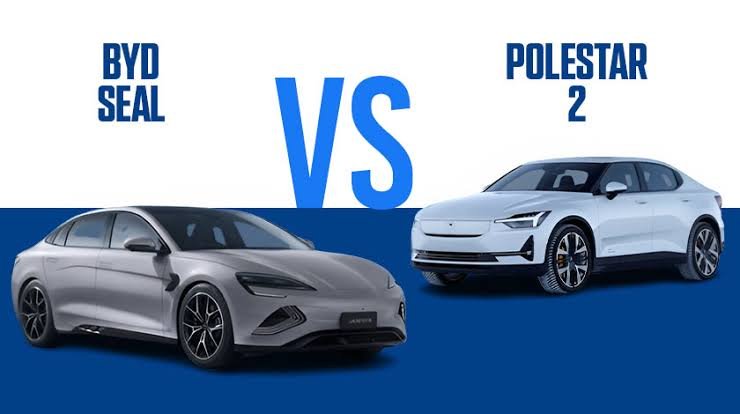
Table of Contents
- Overview: Two Very Different EV Sedans
- BYD Seal vs Polestar 2 Canada: Price Comparison
- Range, Battery Tech, and Real-World Driving
- Performance: Acceleration and Handling
- Charging Speed and Canadian Infrastructure
- Design, Interior, and Tech Features
- Availability in Canada: Dealers and Timelines
- Rebates and Tariffs: The Fine Print Canadians Need to Know
- Total Cost of Ownership
- Which EV Sedan Should You Buy?
- FAQs
Overview: Two Very Different EV Sedans
On paper, the BYD Seal and Polestar 2 look like natural rivals both are electric sedans, both are built in China, and both are gunning for the same Tesla Model 3 shopper. In practice, they represent two opposite strategies for cracking the Canadian EV market.BYD Seal vs Polestar 2 Canada
The BYD Seal is BYD’s flagship sedan and the car meant to prove that a mainstream Chinese automaker can deliver premium range and tech at a mid-market price. It rides on BYD’s e-Platform 3.0 and uses the company’s signature Blade Battery, a lithium iron phosphate (LFP) pack that trades a small amount of energy density for durability, thermal stability, and lower cost.BYD Seal vs Polestar 2 Canada
The Polestar 2 is the more established name in Canada, having originally launched here back in 2020 before being pulled from the market in 2025 amid shifting EV tariffs. It’s now returning for the 2027 model year as a simplified, single-trim performance hatchback-sedan with a much higher starting price than before.BYD Seal vs Polestar 2 Canada
Both cars matter to Canadian buyers researching electric sedans in Canada for very different reasons: one is a value disruptor still finding its footing here, the other is a known quantity re-entering at a steeper price.BYD Seal vs Polestar 2 Canada
BYD Seal vs Polestar 2 Canada: Price Comparison
Price is where these two cars diverge the most, and it’s the single biggest factor most shoppers weigh first.
| BYD Seal (2026, Canada) | Polestar 2 (2027, Canada) | |
|---|---|---|
| Starting price | ~$45,000 CAD (projected landed price) | $69,900 CAD |
| Trim availability | Multiple trims expected (Dynamic/Premium/Performance globally) | Single trim: Long Range Dual Motor AWD |
| Federal iZEV rebate | Not eligible (Chinese-built EV exclusion) | Not eligible |
| Retail status | Not yet on sale — launch targeted late 2026 | Orders open now for 2027 model year |
| Standard equipment | Nappa leather, ADAS suite (varies by market) | Pilot, Plus, and Climate packs included, 19″ Aero wheels |
Why the price gap is so wide
The Polestar 2’s price jumped significantly compared to its old $52,600 base in 2025 a roughly $17,000 increase tied to a simplified lineup and the realities of importing under Canada’s revised EV tariff structure. BYD, by contrast, is entering fresh under a new Canada-China trade arrangement that cut the tariff on Chinese EVs from 100% down to 6.1%, subject to an annual import cap. That’s the main reason BYD can target a landed price roughly $25,000 below the Polestar.BYD Seal vs Polestar 2 Canada
If you’re shopping strictly on BYD Seal price Canada searches, know that the number floating around ($45,000) is a projection based on BYD’s global pricing pattern and hasn’t been locked in for Canadian retail yet.BYD Seal vs Polestar 2 Canada
Range, Battery Tech, and Real-World Driving
BYD Seal: The Blade Battery advantage
The Seal’s Blade LFP battery is rated at roughly 570 km WLTP, one of the longest ranges in its price class globally. LFP chemistry doesn’t pack quite as much energy per kilogram as the nickel-based cells in most premium EVs, but it’s more tolerant of daily fast charging, degrades more slowly, and doesn’t rely on cobalt.BYD Seal vs Polestar 2 Canada
Polestar 2: EPA-rated 447 km
The returning 2027 Polestar 2 Long Range Dual Motor is rated at 447 km EPA (previously up to 592 km WLTP in earlier single-motor configurations, before the dual-motor AWD setup traded range for performance). Its 82 kWh gross battery uses a more conventional NMC chemistry.BYD Seal vs Polestar 2 Canada
Winter range in Canada
Range numbers on paper rarely survive a Canadian winter untouched. Owners of both platforms report 20–30% range loss in sustained sub-zero temperatures, so real-world Ontario or Prairie winter range is closer to 400–450 km for the Seal and 320–360 km for the Polestar 2. Anyone cross-shopping should factor in a heat pump (standard on the Polestar 2’s Climate pack) rather than relying on advertised range alone.BYD Seal vs Polestar 2 Canada
Performance: Acceleration and Handling
This is where the two cars start to feel like they’re not even competing in the same category.
- BYD Seal Performance AWD: 0–100 km/h in 3.8 seconds
- Polestar 2 Long Range Dual Motor: 0–100 km/h in 4.5 seconds, 421 hp, 546 lb-ft of torque
On raw numbers, the BYD Seal’s top trim is quicker. But Polestar has spent years tuning chassis dynamics specifically for enthusiast driving — the Polestar 2 is engineered with input from the same team behind Volvo’s performance heritage, and it shows in steering feel and body control through corners. The BYD Seal is composed and quick in a straight line but doesn’t chase the same “driver’s car” reputation.BYD Seal vs Polestar 2 Canada
If 0–100 times are your headline metric, the Seal wins. If you care about how a car feels at 8/10ths on a winding backroad, the Polestar 2 still has the edge.BYD Seal vs Polestar 2 Canada
Charging Speed and Canadian Infrastructure
| BYD Seal | Polestar 2 | |
|---|---|---|
| Max DC fast charge | ~150 kW | ~205 kW |
| Charge port (North America) | CCS1 | CCS1 |
| AC home charging | Level 2 compatible | 11 kW onboard AC |
Polestar’s higher peak DC charging rate theoretically shaves a few minutes off a road-trip top-up, but real-world charging speed depends heavily on the charging network Petro-Canada, ChargePoint, Ivy, and the growing NACS-adapter ecosystem all vary in reliability across provinces. Both cars use CCS1 in North America, which remains the standard at most public Level 3 stations even as more networks add Tesla-style NACS connectors.BYD Seal vs Polestar 2 Canada
Design, Interior, and Tech Features
BYD Seal
The Seal leans conventional compared to BYD’s quirkier Atto 3, with a cleaner, more Tesla-like fastback silhouette. Interior highlights on higher trims include Nappa leather, a rotating central touchscreen (a BYD signature feature), and an ADAS suite with adaptive cruise and lane-centering.BYD Seal vs Polestar 2 Canada
Polestar 2
Polestar’s interior philosophy is minimalist Scandinavian design fewer physical buttons, a portrait-oriented Google-built infotainment system, and premium vegan or wool-blend upholstery options. The 2027 refresh adds an upgraded Qualcomm Snapdragon chip for noticeably faster app loading and smoother Android Automotive performance.
Neither car will feel unfamiliar if you’re coming from a Tesla Model 3 both use similarly screen-centric interiors — but the Polestar’s build quality and material choices reflect its higher price point.BYD Seal vs Polestar 2 Canada
Availability in Canada: Dealers and Timelines
This is arguably the most practical difference between the two.
Polestar 2 is available to order right now through Polestar’s Canadian website and existing Polestar Spaces in Toronto, Montreal, and Vancouver the same retail network that’s been serving Canadian customers since 2020.BYD Seal vs Polestar 2 Canada
BYD Seal is not yet available for retail purchase in Canada. BYD’s official Canadian launch is targeted for late 2026, starting with more than 20 dealerships concentrated in the Greater Toronto Area, Vancouver, Montreal, and Calgary. The Seal will arrive alongside the Atto 3 crossover and Dolphin hatchback in BYD’s first wave, with the ultra-affordable Seagull city car following in a second phase.
If you’re actively browsing BYD Canada’s current lineup and dealer rollout, BYD Canada EV is a good starting point for launch updates, and you can preview upcoming models and configurations in the BYD vehicle shop as availability expands region by region.
Rebates and Tariffs: The Fine Print Canadians Need to Know
Both the BYD Seal and the returning Polestar 2 are built in China, and that matters enormously for what you’ll actually pay.
- Federal iZEV rebate: Both vehicles are currently excluded, since Chinese-built EVs don’t qualify under the federal program’s current rules.
- Import tariffs: Canada’s 2026 trade agreement with China reduced the blanket 100% tariff on Chinese EVs down to 6.1%, but capped imports at 49,000 vehicles for the year — a quota that could affect Seal availability and pricing if demand outpaces the cap.
- Provincial rebates: Quebec and B.C. programs have historically offered EV incentives, but eligibility rules for Chinese-manufactured vehicles are evolving alongside the federal exclusion — check current provincial program terms before assuming either car qualifies.
The bottom line: don’t budget for a rebate on either car unless a program specifically confirms eligibility at the time you buy. Prices quoted for both vehicles are effectively “rebate-free” numbers.
Total Cost of Ownership
Beyond the sticker price, a few ownership factors are worth weighing:
- Battery longevity: LFP chemistry (BYD Seal) generally tolerates frequent 100% charges and daily fast-charging better than NMC chemistry (Polestar 2), which is typically recommended to stay in an 20–80% charge window for long-term health.
- Warranty coverage: BYD’s global warranty pattern includes long battery coverage (commonly 8 years), while Polestar backs its vehicles with a comparable new-vehicle and battery warranty — confirm exact Canadian terms with each brand at time of purchase, since coverage details can shift market to market.
- Dealer network maturity: Polestar has six years of Canadian service history and parts supply; BYD’s service network is brand new here, which is a real consideration for long-term ownership, especially outside major metros.
- Insurance and resale: Resale value for both nameplates in Canada is still largely unproven, since BYD hasn’t sold retail here yet and Polestar’s Canadian sales history was interrupted by its 2025 market exit.
Which EV Sedan Should You Buy?
Choose the BYD Seal if:
- Price-per-kilometre matters more than brand pedigree
- You want the longest range for the lowest cost
- You’re comfortable being an early adopter of a new-to-Canada dealer network
- You can wait until late 2026 for retail availability
Choose the Polestar 2 if:
- You want to buy and drive an EV sedan today, not next year
- You value a mature Canadian dealer and service network
- Driving dynamics and interior materials matter more to you than 0–100 times
- Budget stretches comfortably past $70,000
For most value-conscious Canadian buyers, the BYD Seal represents the stronger long-term proposition once it actually reaches dealer lots — assuming BYD delivers on its projected pricing and range. Buyers who need a car now, with an established support network, will find the Polestar 2 the more dependable near-term choice, even at a real premium.
If you’d like to compare configurations, colours, and available trims as BYD’s Canadian lineup rolls out, the BYD Canada EV shop is the best place to track what’s actually available in your province, and the BYD Canada EV homepage keeps an updated timeline on dealership openings near major cities.
FAQs
Is the BYD Seal available in Canada right now?
Not yet. BYD’s Canadian retail launch is targeted for late 2026, starting in the Greater Toronto Area, Vancouver, Montreal, and Calgary before expanding nationally.
How much does the BYD Seal cost in Canada?
Projected landed pricing is around $45,000 CAD, though official Canadian retail pricing hasn’t been confirmed by BYD yet.
Why did the Polestar 2 leave and return to the Canadian market?
Polestar paused Canadian sales in 2025 due to tariff changes on Chinese-built EVs, then reopened orders for the 2027 model year at a higher starting price of $69,900 CAD under a simplified single-trim lineup.
Do the BYD Seal or Polestar 2 qualify for the federal EV rebate?
No. Both vehicles are currently excluded from the federal iZEV rebate program because they’re manufactured in China.
Which has better range, the BYD Seal or Polestar 2?
The BYD Seal’s Blade Battery is rated around 570 km WLTP, ahead of the Polestar 2 Long Range Dual Motor’s 447 km EPA-estimated range.
Which is faster, the BYD Seal or Polestar 2?
The BYD Seal Performance AWD trim accelerates 0–100 km/h in 3.8 seconds, quicker than the Polestar 2’s 4.5-second time.
Is BYD a reliable brand for Canadian buyers?
BYD is the world’s largest EV manufacturer by volume, but it has no retail or service history in Canada yet, making long-term reliability and support an open question for early Canadian buyers.
Both of these sedans are worth watching closely over the next year, since pricing, rebate eligibility, and availability are all still moving targets in Canada’s EV market. Would you like this turned into a downloadable Word document or published as a formatted page for your site?